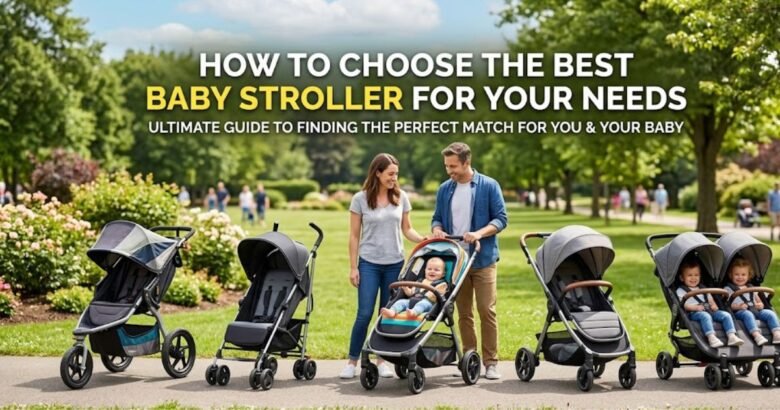
Choosing the best baby stroller is an important decision for every parent, as it directly affects your baby’s comfort and your daily convenience. With so many options available, it’s essential to focus on key factors like safety, durability, ease of use, and lifestyle compatibility. Whether you need a lightweight stroller for travel or a sturdy one for everyday use, selecting the right stroller ensures a smooth and comfortable experience for both you and your baby.
What “Choosing a Stroller” Actually Means (Start Here)
Choosing a baby stroller means matching a wheeled transport system to three things at once: your baby’s developmental stage, your daily environment, and your budget ceiling in that order.
Most people do it backwards. They pick a brand or a look, then try to justify the purchase around their lifestyle. Don’t do that.
The stroller you’ll actually love is the one you reach for without thinking — because it folds fast, fits in your car, handles your sidewalks, and doesn’t make your arms ache after a 20-minute walk. Beauty fades. A broken wrist clasp at 6am does not.
The 5 Types of Strollers And Who Each One Is Actually For
Full-Size Strollers
These are the workhorses. Bigger, heavier, more storage. They handle rough pavement well, often accept infant car seats, and are built to last from newborn through toddler age. The trade-off is trunk space and weight some models top 25–30 lbs.
Lightweight / Umbrella Strollers
Under 15 lbs, folds small, usually one-handed. They’re perfect for errands, airport travel, or as a backup stroller once your baby can sit independently (typically around 6 months). Less padding, smaller canopy, minimal storage.
According to Grand View Research (2024), lightweight strollers claimed 38% of the global stroller market the single largest segment. That’s not a coincidence. Urban living and dual-income households drive demand for strollers that don’t require a forklift.
Travel Systems
A stroller frame bundled with an infant car seat. The car seat clicks directly into the stroller — no unbuckling a sleeping baby. This is genuinely useful in the first six months.
Jogging Strollers
Fixed front wheel, air-filled tires, three-wheel frame. Made for running or rough terrain. Most aren’t safe for newborns until babies can hold their heads up independently — check the manufacturer’s minimum age (usually 6 months, sometimes with an infant car seat adapter).
Double Strollers
Side-by-side or tandem (front-to-back). Tandem models are narrower and steer better; side-by-side models give each child their own view and canopy. Both are heavier and harder to navigate through doorways.
Quick Comparison
| Type | Best For | Key Benefit | Limitation |
| Full-Size | Suburban, single child | Durability, storage | Heavy, bulky trunk footprint |
| Lightweight | Urban life, travel | Portability, one-hand fold | Less padding, smaller canopy |
| Travel System | Driving families, newborns | Car seat compatibility | Pricier, heavier frame |
| Jogging | Active, outdoor parents | Terrain handling, stability | Not for newborns under 6 months |
| Double | Twins or two young kids | Carries both children | Wide, harder to maneuver |
The Newborn Problem Most Guides Completely Miss

Most full-size strollers aren’t safe for newborns right out of the box.
Why? Because newborns can’t hold up their heads. Their necks are not strong enough. Placing a newborn in a stroller that only partially reclines say, to 150 degrees instead of fully flat puts pressure on their airway in a way that can restrict breathing. The American Academy of Pediatrics (AAP) guidelines are clear on this: babies under 6 months should only ride in strollers that either recline completely flat, accept an infant car seat, or include a certified bassinet attachment.
Or maybe I should say it this way the weight limit on a stroller is almost never the issue for newborns. The real safety question is whether the stroller protects their spine and airway. Most buying guides lead with weight limits. That’s the wrong starting point.
To choose a stroller for a newborn, check these things first:
- Does the seat recline fully flat (180 degrees), or does it have a certified bassinet mode?
- Is there a compatible infant car seat that clicks into the frame?
- Does the harness have 5-point attachment shoulder, waist, and between the legs?
The Safety Features That Actually Matter (And One You Can Ignore)
Five-point harness. Non-negotiable. Straps over both shoulders, across the waist, and between the legs. This keeps the child in the stroller if it tips — and strollers do tip, especially when older children are more active.
Brakes. The best brakes lock two rear wheels, not one. Foot-activated is safer than handle-activated, since you can’t accidentally release it by brushing against it. Always engage the brake on any incline — even a “flat” parking lot has micro-slopes.
Wide, stable base. Pick up the stroller by its handlebars and push down gently. It should not tip backward. The base should be wider than the seat. Simple physics.
One thing you can probably stop obsessing over: cup holders. They’re nice. They’re not safety features. Don’t let a cup holder be the reason you choose a $900 stroller over a $350 one.
Look if you’re in a city apartment on the third floor with no elevator, the stroller’s folded weight is the feature that determines whether you actually use it. A stunning-looking stroller that weighs 28 lbs will stay in the hallway. Every time.
What to Look for in a Stroller Beyond Safety
Once safety is covered, these are the practical features that separate a stroller you love from one you tolerate.
Fold Mechanism
This is arguably the most underrated factor. Practice folding every stroller you consider in the store, with one hand, while holding something in the other arm. Some mechanisms that look simple in a YouTube video are genuinely awkward when you’re also holding a crying infant.
Quick note: one-hand folds are not all created equal. Some require a two-step button press plus a kick. “One-hand fold” is marketing until you try it yourself.
Weight
On stairs, on public transit, into the trunk the stroller’s weight affects your daily life in ways that are easy to underestimate at the store. If you don’t drive and you take public transit or stairs regularly, prioritize weight above almost everything else.
Wheel Type
Air-filled (pneumatic) tires absorb shock better on rough terrain. Foam-filled tires don’t go flat. Hard plastic wheels roll smoothly on flat commercial flooring but transmit every crack in the pavement directly to your baby.
Handlebar Height
If there’s a meaningful height difference between you and your partner, adjustable handlebars matter a lot. Pushing a stroller that’s too low or too high for you for 45 minutes is genuinely uncomfortable.
Storage Basket
Bigger opening is better than bigger volume. A vast basket with a 4-inch access gap is less useful than a smaller basket you can actually reach into while holding the stroller with one hand.
Some parents I’ve seen struggle most with this: the basket is technically big, but the seat angle when reclined blocks the opening almost completely.
Travel System vs Regular Stroller A Direct Answer
A travel system is better suited for driving families with newborns because the infant car seat clicks in without disturbing a sleeping baby. A standalone stroller works better when you primarily walk, use transit, or already own a car seat from a different brand. The key difference is whether seamless car-to-stroller transfer is part of your actual daily routine.
Travel systems tend to cost more upfront brands like Graco offer solid mid-range options in the $250–$450 range. UPPAbaby sits in the premium tier ($900–$1,100 for a full VISTA travel system) with significantly more modularity. Both are widely trusted for safety certifications.
I’ve seen conflicting opinions on this: some parenting communities argue travel systems get too heavy too quickly and you’d have been better off buying a lightweight stroller from the start. Others swear by them for the first year. My read is that the answer depends entirely on how much time your baby spends in the car. If you drive daily, the convenience of not unbuckling a sleeping newborn is worth the weight. If you don’t drive often — skip it.
Brands Worth Knowing (Without the Hype)
Three names worth having on your radar before you shop:
Graco Widely available, mid-range pricing, reliable safety record. Their travel systems are a practical entry point and have been JPMA certified for years. Good pick if budget is a real constraint.
UPPAbaby Premium build quality, modular design (seat can face forward or backward, bassinet available), strong resale value. The VISTA is a legitimate long-term investment if you plan on more than one child. Expensive upfront, but the math changes if you use it for 3+ years.
Babyzen YOYO The city stroller. Folds to carry-on luggage size, weighs under 14 lbs, accepted in most airline cabins. Not the most feature-rich stroller, but it’s one of the most practical options if you live in a dense urban area or travel frequently with your baby.
Conclusion
Choosing the best baby stroller comes down to understanding your daily routine, budget, and your baby’s comfort needs. A good stroller should be safe, durable, easy to handle, and suitable for your lifestyle whether you’re traveling, shopping, or going for daily walks. By focusing on essential features like safety harnesses, wheel quality, storage, and portability, you can make a smart choice that makes parenting more convenient and stress-free.
FAQs
What’s the best stroller for a newborn?
A stroller with a fully flat recline, a bassinet attachment, or compatibility with an infant car seat. The seat must support the baby’s head and spine. Any stroller without this isn’t safe for newborns.
How do I know if a stroller is safe?
Look for a 5-point harness, two-wheel locking brakes, JPMA certification, and a wide base that doesn’t tip backward when you push down on the handles. Check CPSC recalls before buying secondhand.
Should I buy a travel system or just a stroller?
If you drive regularly with a newborn, a travel system saves you from constantly unbuckling a sleeping baby. If you mostly walk or use transit, a good standalone stroller plus a separate infant car seat works fine.
When can my baby use a regular stroller seat?
Around 6 months, once they can hold their head up without support. Before that, use a stroller that reclines flat or supports an infant car seat.
Why does a good stroller cost so much?
Frame materials, suspension quality, safety certifications, and wheel durability drive the price. You don’t need to spend $900. But strollers under $80 typically cut corners on frame stability and harness quality the two things that matter most.