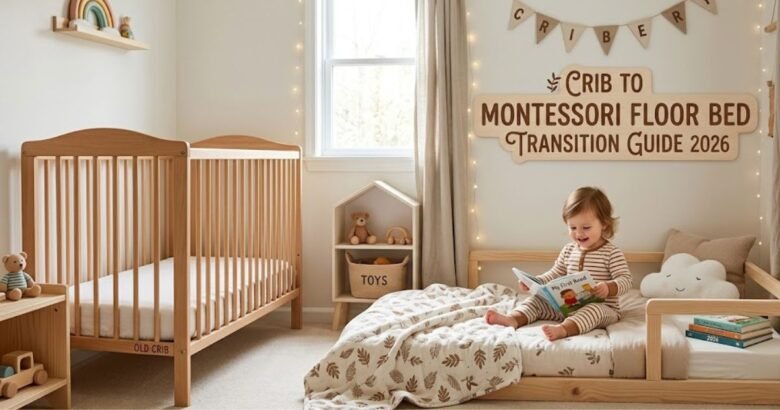
Transitioning from a crib to a Montessori floor bed in 2026 is a practical way to support your child’s independence and better sleep habits. Floor beds allow toddlers to move freely, explore safely, and develop confidence within a child-friendly environment. With proper room setup and safety measures, the shift can be smooth and stress-free for both parents and children.
What Made Us Actually Pull the Trigger
A lot of parents sit in the “thinking about it” phase for months. We did too. The tipping point wasn’t a philosophy. It was a safety calculation.
According to the American Academy of Pediatrics (AAP, 2022), once a child can climb out of a crib or reaches 35 inches in height, remaining in a crib becomes a fall risk and a fall from a standard crib height can mean a 3-foot drop onto a hard floor. A floor bed eliminates that risk entirely. The floor IS the landing zone.
most parents frame this transition as “giving the child freedom.” That’s true, but it’s actually the wrong frame if you’re on the fence. The better frame is removing a hazard that’s about to appear anyway.
Some pediatric sleep experts argue children sleep better with the physical containment of a crib and that’s valid for children under 18 months who don’t yet have the impulse control to stay put. But Lee was nearly 20 months, was clearly ready to self-exit, and had a consistent sleep routine already locked in. For that scenario, waiting longer actually added risk, not comfort.
Three Weeks Before the Transition What We Did (and One Thing We Almost Skipped)
Week one was purely conversational. We started talking about “Lee’s big bed” at breakfast, bath time, and during our pre-nap wind-down. Not as a scary change as something exciting that was coming soon. Toddlers process change through repetition. You can’t mention it once and expect it to land.
We found a copy of Your Own Big Bed by Rita Bergstein at our local library. Lee asked for it every single night within four days. There’s something about seeing an animal character grow out of its small space that clicks for toddlers in a way that direct explanation doesn’t.
Week two we showed him pictures of the actual bed. We’d ordered a Sprout Kids floor bed frame the crib-size version, so we could use a firm crib mattress rather than switching to a full mattress too early. We printed a photo and taped it to his bedroom door. He’d point at it and say “Weee bed” every time we walked past.
Week three was room prep. This took longer than expected. Getting down on hands and knees and scanning the room from a 20-inch sightline is a completely different experience than standing at the doorway doing a visual sweep. We found three things we’d missed entirely: a power strip behind the dresser, a gap between the bookshelf and the wall that a small hand could wedge into, and a lamp cord that ran along the baseboard.
We also installed a door knob cover on the inside of his room door not to trap him, but to slow down any wandering so we’d hear him before he reached the hallway.
To childproof a toddler’s room for a floor bed transition, follow these steps:
- Get on your hands and knees and scan at the child’s eye level.
- Anchor all furniture taller than 24 inches to the wall.
- Cover all outlets and reroute or hide all exposed cords.
- Install a door handle cover to create a noise-making delay.
- Remove soft objects, extra pillows, and loose bedding from mattress level.
The Bed Setup What We Used and Why

We went with the Sprout Kids floor bed frame in crib size, paired with a Newton Baby Crib Mattress. The Newton mattress was a deliberate choice it’s firm, breathable, and GREENGUARD Gold certified, which mattered to us since it was now sitting at floor level where air circulation is lower than on a raised frame.
Quick Comparison Floor Bed Options
| Option | Best For | Key Benefit | Limitation |
| Sprout Kids Frame (crib size) | Ages 5–24 months | Uses safe crib mattress, has airflow | Outgrown faster, higher cost |
| IKEA KURA low bed | Toddlers 2+ | Affordable, widely available | Too high for true floor-bed feel |
| Etsy house bed frame | Design-focused families | Beautiful aesthetic, customizable | Inconsistent safety standards |
| Mattress directly on floor | Budget-first approach | Cheapest option, zero fall risk | Moisture buildup underneath |
We ruled out putting the mattress directly on the floor for two reasons: moisture accumulation underneath, and the fact that the Sprout frame only raises the mattress about 3 inches which still counts as a floor bed but allows air to circulate.
Nights One Through Five The Honest Version
Night one went better than expected. Lee wandered to the door once, we heard the handle cover rattling, went in, said “it’s sleep time,” and put him back. He was asleep within 12 minutes of us leaving. We watched the monitor like it was a live sporting event.
Naps were harder. This is the part that almost no transition article covers honestly, and it’s where most parents hit a wall.
Lee started using nap time as exploration time. Day two nap: 25 minutes of wandering the room before finally lying down on the floor next to the bed. We left him. He slept there for 90 minutes. We counted it as a win.
Day three nap: same wandering, but this time he dragged his stuffed elephant off the bed and onto the floor and fell asleep next to it.
Look if your child is on day three and still fighting every nap, that’s not a sign the transition is failing. That’s just day three. The adjustment window for most toddlers is between five and ten days, with naps typically taking longer to regulate than nighttime sleep.
I’ve seen conflicting data on this some Montessori sleep coaches say a week is normal, others say two weeks for nap normalization specifically. My read is that nap resistance lasting beyond two weeks probably warrants a closer look at the overall sleep schedule, not the bed itself.
What We’d Do Differently
Three things.
We’d do the transition mid-week, not on a weekend
We switched on a Saturday thinking we’d have two days to “manage” it. What actually happened is that we were home and hovering. A mid-week transition means shorter days before a routine kicks back in.
We’d get the bed bumper earlier
By night two, Lee had rolled so that his feet were hanging off the edge not far, but enough to startle him awake. We ordered a foam bed rail bumper that sits under the fitted sheet. It arrived day four. We should’ve had it on day one.
We’d prepare ourselves, not just Lee
This is the thing nobody writes about. The crib is not just a safety device for your child — it’s a psychological container for the parent. There’s a low-grade anxiety that kicks in when you close the door and realize there’s nothing physically keeping your kid in that bed. That feeling is real. It doesn’t mean you made the wrong choice. It means you’re paying attention.
Conclusion
Moving to a Montessori floor bed is more than just changing furniture—it’s about encouraging independence and creating a calm, accessible sleep space. With patience, consistency, and a safe setup, most children adapt quickly. In 2026, this approach continues to be a popular choice for parents focused on child-led development.
FAQs
What’s the best age to switch from a crib to a Montessori floor bed?
Most Montessori families transition between 14 and 24 months. The AAP recommends waiting until at least 12 months. The real trigger is when a child begins attempting to climb out of the crib.
How do I keep my toddler in a floor bed at night?
A consistent re-entry script, a door handle cover to slow wandering, and a predictable sleep routine do more than any physical barrier. Most toddlers self-regulate within five to ten days.
Should I use a crib mattress or a regular mattress for a Montessori floor bed?
For children under 24 months, a firm crib mattress is safer than a soft adult mattress. The Newton Baby and Naturepedic crib mattresses are commonly recommended for floor use.
Why does my toddler sleep on the floor next to the floor bed instead of in it?
This is extremely common in the first week. The floor is familiar, low, and non-threatening. Most children migrate back to the mattress within a few days. Don’t move them unless it’s a safety concern.
When should I go back to the crib if the floor bed isn’t working?
If sleep deprivation is affecting the child’s health or the family’s functioning after two full weeks, a short reset period in the crib is reasonable it’s not failure. Revisit the transition in four to six weeks.