
Contact naps for babies involve a caregiver holding or staying in close physical contact with the baby while they sleep, which can help promote comfort, security, and better bonding. Many parents find that contact naps soothe fussy infants and encourage longer, more restful daytime sleep. However, it’s important to follow safe sleep practices such as ensuring proper positioning, avoiding soft or unsafe surfaces, and staying alert to reduce any risk and keep the baby safe during these naps.
What Contact Napping Actually Is (And What It Isn’t)
Contact napping is when a baby sleeps while held against a caregiver’s body in arms, on a chest, or in a carrier with the caregiver remaining awake. One clarifying point most articles blur: contact napping is not co-sleeping. Co-sleeping involves a sleeping adult sharing a sleep surface with the baby, which carries entirely different risks.
Contact naps have been happening since humans existed. The term itself is modern social media named it but the practice predates cribs by roughly a hundred thousand years.
Are Contact Naps Safe? The Real Answer
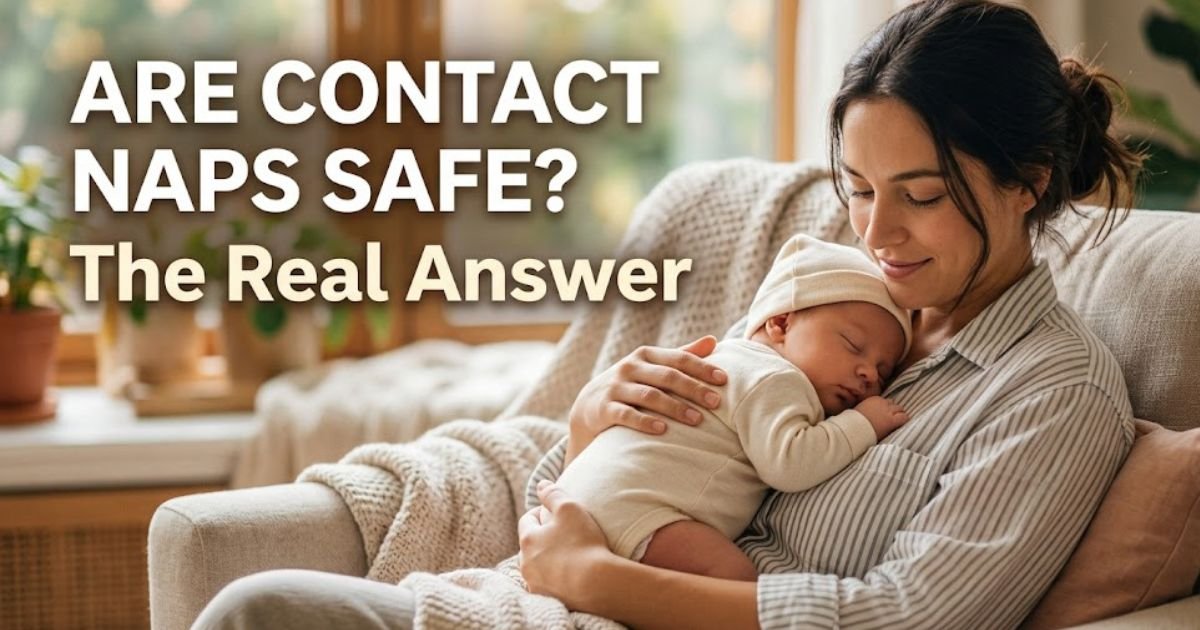
According to the American Academy of Pediatrics (AAP) 2022 Safe Sleep Policy Statement, the danger in contact napping isn’t the contact it’s caregiver sleep. A UK Lullaby Trust survey found that over 40% of parents have fallen asleep on a sofa or rocking chair while holding their baby, and a 2018 study published in Pediatrics found that 36–66% of in-hospital neonatal falls involved a caregiver who had nodded off, often during a feeding session.
The surface matters, too. Falling asleep while holding a baby on a firm chair is dangerous. On a sofa or armchair, it’s significantly more so soft, angled surfaces can cause a baby’s head to slump forward, blocking the airway.
Quick safety protocol for solo caregivers who feel drowsy:
- Move baby to a safe sleep surface (firm crib, bassinet, or play yard) immediately even if they wake up
- Set a phone alarm for 20 minutes before attempting to hold baby again
- Never move to a sofa or armchair when fatigue is setting in
The Carrier Problem Nobody Talks About
Most guides discuss contact napping in arms. Fewer address what happens in a baby carrier or wrap which is a separate and specific safety concern.
The AAP recommends moving a baby to a firm, flat sleep surface as soon as possible if they fall asleep in a carrier. The reason: in a carrier, you cannot always see if the baby’s nose or mouth is obstructed. Chin-to-chest positioning where the baby’s head drops forward toward their chest can partially block the airway even when everything looks fine from the outside.
If babywearing naps are your reality (and for many parents they are), run the T.I.C.K.S. check from the UK Sling Consortium before every nap:
- T Tight: carrier is snug, not saggy
- I In view at all times: face visible, never covered
- C Close enough to kiss: baby’s head near your chin
- K Keep chin off chest: at least one finger’s width of space
- S Supported back: curved, not slumped
The Solly Baby wrap carrier and similar stretchy wraps are popular for newborn contact naps precisely because they hold babies in a more ergonomically neutral position. That doesn’t eliminate the monitoring requirement it just makes safe positioning easier to achieve.
What Contact Napping Actually Does for Your Baby
Studies of kangaroo care (skin-to-skin contact in clinical settings) consistently show reduced infant crying, better nursing outcomes, and more time spent in deep sleep. Contact napping and kangaroo care aren’t identical, but they’re mechanically similar. According to the AAP’s own review of skin-to-skin evidence, these practices appear to support longer, more restorative sleep in newborns.
Newborns spend up to 75% of sleep time in active (REM) sleep. They cycle through light sleep constantly. When held, a caregiving adult’s instinctive patting or swaying bridges those micro-awakenings something a crib cannot do on its own.
Some experts argue this creates dependency. That’s valid for older infants who’ve already developed the neurological capacity to self-soothe. But for babies under 4 months, the dependency is developmentally appropriate. The fourth trimester framework popularized by Dr. Harvey Karp of Happiest Baby proposes that newborns need approximately three months of close physical contact to replicate what the womb provided. You’re not creating a problem. You’re meeting a biological need.
The Honest Drawbacks
The “nap trap” is real being physically unable to move, work, eat, shower, or exist as a human for 45 minutes at a stretch, multiple times a day. For some parents, this is a meaningful sacrifice. For others, it’s time they’ve decided is worth it.
The longer-term concern is genuine: babies who contact nap exclusively do tend to take longer to develop independent sleep. They haven’t had the chance to practice the skill of settling themselves at sleep-cycle transitions. That doesn’t mean they can’t learn it all healthy babies eventually do but it means you’ll likely need an intentional transition plan rather than hoping they figure it out on their own.
I’ve seen conflicting data on exactly when this becomes harder to reverse some sources suggest 4 months, others say 6. My read is that the 4-month mark is when the transition starts costing more effort, not that 5 or 6 months is a point of no return.
Contact Nap vs. Independent Crib Nap Quick Comparison
| Option | Best For | Key Benefit | Limitation |
| Contact nap (held) | Newborns 0 4 months | Supports bonding, extends nap length | Requires caregiver to stay awake and present |
| Carrier nap | Active parents, errand-running | Hands-free mobility | Airway monitoring required; not a long-term sleep solution |
| Crib/bassinet nap | Babies 3+ months building independence | Teaches self-settling; safer unsupervised | Shorter naps initially; requires transition work |
| SNOO Smart Sleeper | Transition phase off contact naps | Responsive motion mimics being held | Expensive; works best under 6 months |
How to Stop Contact Napping (Without a Week of Screaming)
To transition from contact naps to crib naps, follow these steps:
- Start white noise during contact naps now, before any crib attempt
- Work on bedtime independence first nighttime sleep consolidates before naps do
- For crib transfers: place baby down, then gently rouse them with a toe tickle so they wake just enough to re-settle on their own
- Keep one contact nap per day while building crib success with the others
- Add the Hatch Rest+ or similar white noise machine near the crib as a consistent sleep cue
The Hatch Rest+ is worth a specific mention here: the ability to set the same sound profile during contact naps and crib naps gives the baby a sensory bridge between the two environments. It’s not magic but continuity of cues matters more than most parents realize.
What most guides skip is the feeding-to-sleep connection. If your baby is falling asleep mid-feed before the actual nap begins, that micro-nap reduces the sleep pressure needed for a real nap. After the two-week mark, aim to keep your baby awake through the end of a feed before the nap window opens.
Conclusion
Contact naps can be a comforting way to bond with your baby and help them rest, but safety should always come first. By following safe sleep guidelines like ensuring a clear airway, staying awake, and transitioning to a safe sleep surface when possible you can enjoy the closeness without increasing risk. Balance is key: cherish the connection while building habits that support your baby’s long-term sleep health.
FAQs
Are contact naps safe for newborns?
Yes, as long as the caregiver stays fully awake. The AAP identifies caregiver sleep not physical contact as the primary risk during held naps. Move baby to a firm sleep surface the moment you feel drowsy.
What’s the difference between a contact nap and co-sleeping?
Contact napping means holding an awake-alert caregiver’s baby while the baby sleeps. Co-sleeping involves a sleeping adult sharing a surface with the baby, which carries significantly higher SIDS risk.
How do I stop contact napping without my baby crying constantly?
Start with white noise during contact naps, then use the same sound for crib naps. Work on bedtime independence before daytime naps sleep consolidates in that order naturally.
When should I stop contact napping?
There’s no hard deadline. Most sleep consultants suggest beginning the transition around 4 months, when independent sleep skills start becoming more teachable and before strong habits solidify at 6–7 months.
Why does my baby only sleep when held?
Newborns have spent months in a warm, motion-filled, sound-rich environment. A flat, still, silent crib is the opposite of that. The held preference is neurologically normal, not a parenting mistake.