
Removing contact lenses should feel quick and comfortable not stressful or painful. The key is using clean hands, staying calm, and following the right technique so the lens comes out smoothly without irritating your eye. Whether you’re a beginner or just struggling with a stubborn lens, this guide will help you safely remove your contact lenses step by step, while keeping your eyes protected and pain-free.
What Getting Contact Lenses Out Actually Means
How to get contact lenses out means using clean, dry fingertips to gently pinch or slide a soft lens off the surface of your eye. The lens sits on your cornea (the front, coloured part), not attached to it so it can always be removed. No lens has ever been permanently trapped in a human eye.
According to the CDC, roughly 45 million Americans wear contact lenses. Yet surveys from VisionCenter.org (2024) found that around 30% of wearers feel under-informed on proper care and removal that’s nearly 13 million people who were handed a lens case and sent home without enough practice.
Before You Touch Your Eye: The Setup That Makes Everything Easier
Wash your hands with unscented, lotion-free soap. Rinse completely. Then dry them really dry them with a lint-free towel. Wet fingers can’t grip a soft lens. It’ll just slide around.
Stand under good overhead lighting in front of a mirror. Close the drain. Put a clean towel over the sink basin so a dropped lens doesn’t disappear.
That’s it. Don’t overthink the setup.
Quick note: If you use hand sanitiser, wait until it has completely evaporated before touching your lenses. Any residue near your eye will cause immediate, intense stinging.
Two Methods for Removing Soft Contact Lenses
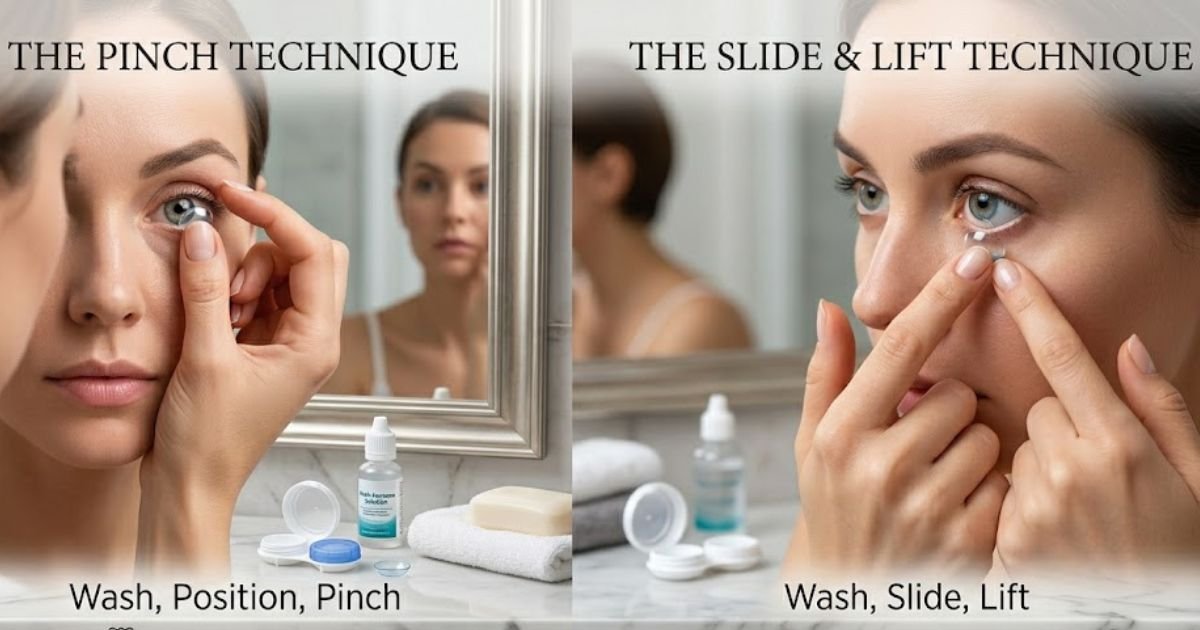
Method 1 The Pinch Method (Most Common)
This is what most opticians teach. It’s fast once you’re comfortable with it.
To remove a soft contact lens using the pinch method:
- Look upward and hold your lower eyelid down with your middle finger
- Place your index finger lightly on the lower edge of the lens
- Slide the lens gently down onto the white of your eye
- Pinch the lens softly between your index finger and thumb
- Lift it away from your eye in one smooth motion
Keep your fingers dry at the pinch step. Wet fingers let the lens slip.
Method 2 The Slide Method (Better for Anxious Removers)
Look if you’re genuinely terrified of touching the front of your eye, the slide method is what actually works for you. It uses your eyelid to fold the lens rather than your fingers gripping the lens directly.
Look to the side. Place your index finger on the outer edge of the lens. Slide it toward the corner of your eye. As it moves off the cornea, close your eyelids gently and let the lens fold naturally. Open your lids slightly and catch the folded lens with your fingertips.
What to Do When the Lens Feels Completely Stuck
Here’s the thing a “stuck” lens is almost always a dry lens. It hasn’t fused to your eye. It’s just dehydrated and clinging more tightly than usual — especially after a long screen-heavy day when you’ve been blinking far less than normal.
Step one stop trying to pull it out.
Instead, put 2 3 drops of a rewetting solution directly into your eye. Good options include Refresh Contacts rewetting drops or Bausch + Lomb Sensitive Eyes Saline Solution — both are compatible with soft lenses and safe to use without removing the lens first. Wait 60–90 seconds. Blink slowly several times.
Then try again.
If the lens has slid off-centre or migrated toward the corner of your eye (you’ll feel a strange pressure rather than central discomfort), this is where most guides fail you: don’t panic, and don’t prod blindly. Close your eye and use a fingertip to gently press the outside of your eyelid, nudging the lens back toward the centre of your eye. Then apply drops and try the slide method.
Removing Contacts With Long Nails (Yes, It’s Possible)
Use the pads of your fingers the soft, fleshy part not your fingertips. Keep your nail curled away from the eye surface. The slide method is generally safer here than the pinch method, since it involves less direct contact with the lens and requires less grip precision.
Consider using a silicone contact lens remover tool if nail length makes the pinch method genuinely unworkable. Your optician may recommend one though the ACUVUE clinical team notes that it’s worth being able to remove lenses with fingers alone for situations where a tool isn’t available.
Quick Comparison Pinch vs. Slide Method
| Method | Best For | Key Benefit | Limitation |
| Pinch Method | Most wearers, shorter nails | Fastest removal, widely taught | Requires comfort touching the cornea directly |
| Slide Method | Anxious beginners, long nails | Less direct eye contact, eyelid-assisted | Takes slightly longer to learn |
| Rewetting First | Stuck or dry lenses | Loosens lens without force | Needs drops nearby; adds 1–2 minutes |
| Eyelid Massage | Off-centre lenses | Repositions lens without probing | Only applicable to migrated lenses |
When to Stop and Call Your Eye Doctor
Some experts argue you should always visit a professional if a lens won’t come out after one attempt. That’s valid if you’re in significant pain or see a visible change in your vision. But if you’re simply struggling with the mechanics of removal that’s a technique problem, not a medical emergency.
Stop attempting removal and call your optician or eye doctor if:
- You’ve applied drops and waited, and the lens still hasn’t moved after 10 minutes
- You feel sharp pain rather than mild irritation
- Your vision changes or worsens during removal attempts
- You suspect the lens has torn inside your eye
Conclusion
Removing contact lenses doesn’t have to be uncomfortable if you follow the right steps and stay gentle with your eyes. Always wash your hands, keep your eyes relaxed, and avoid rushing the process to prevent irritation or damage. With proper care and practice, taking out your contact lenses becomes quick, safe, and completely pain-free. If you still feel discomfort, it’s best to rest your eyes or consult an eye specialist.
FAQs
How do I get a contact lens out if it won’t come out?
Apply 2 3 drops of rewetting solution, wait 60 seconds, and blink slowly. The lens is likely dry and clinging. Don’t force it rehydrate first, then try the slide method.
What’s the best method for removing contacts for the first time?
The slide method is easiest for nervous beginners. Slide the lens to the white of your eye before pinching it reduces anxiety about touching your cornea directly.
Should I use a contact lens removal tool?
Only if your eye doctor recommends one, typically for people with limited finger dexterity or very long nails. Most wearers can learn fingertip removal with practice.
Why does my contact lens feel stuck at the end of the day?
Screen time reduces blinking, which dries out lenses. According to ACUVUE, this is one of the most common causes of lenses feeling “glued” to the eye by evening.
When should I go to a doctor instead of removing the lens myself?
If the lens hasn’t moved after applying rewetting drops and waiting, if you feel sharp pain, or if your vision changes stop and call your eye doctor immediately.