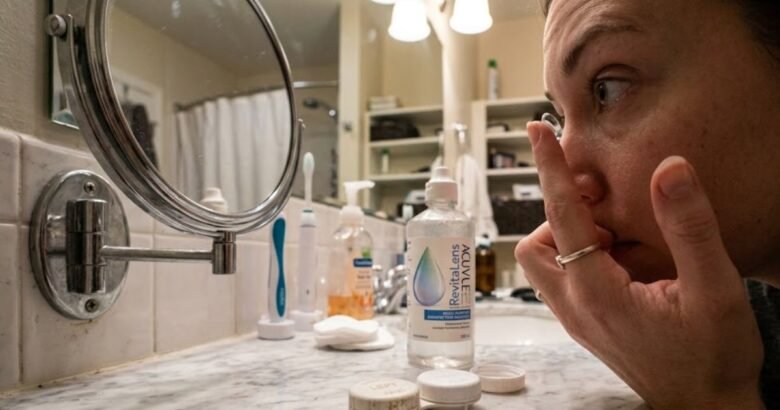
Using expired contact lens solution is not recommended, as it can pose serious risks to your eye health. Over time, the disinfecting agents in the solution lose their effectiveness, making it less capable of killing harmful bacteria and germs. This increases the chances of eye infections, irritation, and discomfort. To keep your eyes safe and your lenses clean, it’s always best to use fresh, unexpired solution and follow proper hygiene practices.
What “Expired” Actually Means on a Contact Solution Bottle
That tiny expiration date printed on your contact solution bottle isn’t just a formality—it’s a safety deadline. It tells you the last date the manufacturer guarantees the solution will remain sterile, stable, and effective. After this point, the ingredients that clean and disinfect your lenses may begin to break down, making the solution less reliable and potentially harmful for your eyes.
Loss of Disinfecting Power
Over time, the active ingredients in contact solution—designed to kill bacteria and remove debris—start to weaken. Once expired, the solution may no longer effectively eliminate harmful microorganisms. This increases the risk of eye infections, irritation, and even serious complications if contaminated lenses are used.
Risk of Contamination After Expiry
An expired solution is more vulnerable to contamination, especially if the bottle has already been opened. Preservatives lose their strength, allowing bacteria or fungi to grow inside the solution. Using such a solution can expose your eyes to harmful pathogens, leading to redness, discomfort, or infections.
The Two Scenarios They’re Not the Same Risk
Quick Comparison
| Scenario | Bottle Status | Primary Risk | Urgency |
| Unopened, slightly past expiry (1–3 months) | Sealed | Reduced disinfecting power | Moderate — don’t make a habit of it |
| Unopened, long past expiry (6+ months) | Sealed | Significant preservative degradation | High — replace it |
| Opened, within expiry date, but >90 days old | Open | Contamination from repeated handling | High — discard immediately |
| Opened AND past expiry | Open | Both degraded chemistry + active contamination | Severe — never use |
The competitor articles you’ve probably already read treat these as one situation. They’re not.
An unopened bottle that expired three weeks ago is a different problem from a bottle you’ve been dipping your fingers around the nozzle of for four months. The first has degraded preservatives. The second may have live bacteria in the solution itself.
What Actually Happens to Your Eyes
When you use expired contact lens solution, your eyes are exposed to a higher risk of irritation and infection. Since the solution may no longer properly disinfect your lenses, harmful bacteria and debris can remain on the surface. This can lead to redness, dryness, blurred vision, and a burning sensation. In more serious cases, it may even cause painful eye infections that require medical treatment.
Common Symptoms and Possible Complications
You might first notice mild discomfort, such as itching or watery eyes, but these symptoms can quickly worsen. Continued use of expired solution can result in conditions like conjunctivitis (pink eye) or corneal infections, which may affect your vision if not treated promptly. That’s why it’s important to stop using any expired solution immediately and switch to a fresh, safe alternative.
How to Check If Your Solution Is Still Safe (Step-by-Step)
To assess your contact solution before use, follow these steps:
- Find the expiration date check the back label, usually near the bottom.
- Check whether the bottle has been opened before; if yes, find the discard window printed on the label (typically 90 days).
- Smell and inspect the solution any cloudiness, unusual odor, or visible particles means discard immediately.
- Check the nozzle tip for visible residue or crusting, which signals contamination risk.
- When in doubt, buy a new bottle. A $12 replacement is not worth a corneal infection.
The Brands Whose Labels Most People Don’t Actually Read
Bausch + Lomb Biotrue and ReNu both print “discard 90 days after opening” on their packaging. Most wearers report never having noticed this. Alcon Clear Care Plus, the hydrogen-peroxide system, works differently it requires a full neutralization cycle in its special case before lenses can be worn, which also limits how it ages once opened.
I’ve seen conflicting data on exactly how fast multipurpose solution preservative concentrations fall after opening some lab studies that suggest meaningful degradation begins around 60 days, others cite 90 as the safe outer limit. My read is: treat 90 days as the hard stop, not a suggestion.
What most guides skip is that storage conditions matter as much as the date. A bottle kept in a hot car glove compartment degrades faster than one in a cool medicine cabinet. Heat accelerates the breakdown of polyhexanide and similar preservatives significantly.
Conclusion
Using expired contact solution is not safe and should always be avoided. Once it passes its expiration date, the solution can lose its disinfecting power and may even become contaminated, increasing the risk of eye irritation and infections. To protect your eye health, always use fresh solution, follow proper lens care routines, and never take chances with expired products.
FAQs
What happens if you use old contact solution?
The preservatives degrade, reducing its ability to kill bacteria and fungi on your lenses. This raises your risk of eye infection, irritation, and corneal damage, especially with lenses worn for extended periods.
How long is contact solution good after opening?
Most multipurpose solutions containing preservatives are safe for up to 90 days after opening. Preservative-free formulas should be discarded much sooner often within 24 hours per use.
QShould I use contact solution that expired a month ago if it’s still sealed?
It’s not recommended. The manufacturer’s sterility and potency guarantee no longer applies. If you’re in a pinch, one-time use of a recently expired sealed bottle carries lower risk than an open old bottle but replace it as soon as possible.
Why does contact solution expire if it’s just saline?
Modern contact solutions aren’t just saline they contain active disinfectants and preservatives that chemically degrade over time. Once degraded, the solution can’t reliably disinfect your lenses.
When should I throw out my contact solution?
Toss it if it’s past the printed expiration date, if it’s been open longer than 90 days, if you notice cloudiness or odor, or if the nozzle has touched any surface including your fingers.