
Orthokeratology is a non-surgical vision correction method that uses specially designed contact lenses worn overnight to temporarily reshape the cornea. This allows people to see clearly during the day without glasses or contact lenses. While it offers benefits like improved daytime vision and freedom from glasses, it also has some drawbacks such as eye discomfort, cost, and the need for strict hygiene.
What Is Orthokeratology, Exactly?
Orthokeratology (often called Ortho-K) is a non-surgical vision correction method that uses specially designed, gas-permeable contact lenses worn overnight. These lenses gently reshape the cornea while you sleep, so you can enjoy clear vision during the day without glasses or daytime contact lenses.
How Orthokeratology Works
Orthokeratology works by applying controlled pressure to the cornea through custom-fit lenses worn at night. This gradually flattens the cornea in a precise way, correcting refractive errors like myopia (nearsightedness) and sometimes mild astigmatism. When the lenses are removed in the morning, the cornea temporarily holds its new shape allowing clear, natural vision throughout the day.
The Real Pros What Ortho-K Does Well
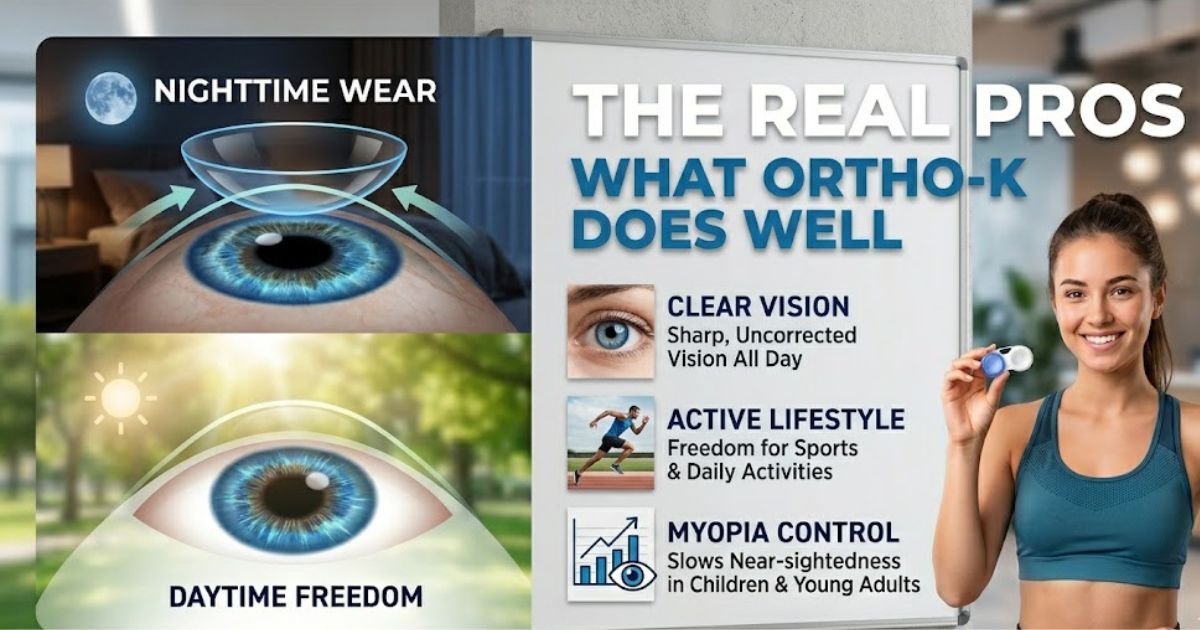
Daytime Freedom Without Surgery
This is the obvious one. Kids can play sports, swim, and sit in the back of a classroom without glasses or soft lenses. Adults don’t deal with dry-eye irritation from all-day soft contact wear or the visual distortion that comes with glasses in certain sports.
For children especially, the practical benefit compounds. No lost glasses on the playground. No social self-consciousness during the years when that matters most.
Myopia Control That Has Real Evidence Behind It
According to a 2024 pooled analysis by Santodomingo-Rubido et al. (Contact Lens and Anterior Eye), ortho-k slowed axial elongation by 0.24 mm over two years compared to spectacle lens wearers in myopic children. Axial elongation matters because each millimetre of extra eye growth meaningfully increases lifetime risk of retinal detachment, glaucoma, and myopic maculopathy.
Compared to other myopia management options including low-dose atropine and myopia control spectacles — ortho-k has the largest single-modality evidence base. A systematic review and meta-analysis published in PMC (2024) confirmed that the rate of axial elongation in children was lower for ortho-k compared to other treatment modalities at one year.
Quick Comparison: Myopia Control Options
| Option | Best For | Key Benefit | Limitation |
| Ortho-K | Active kids, sport-heavy lifestyles | Strong axial length control + daytime freedom | Nightly wear required; ~25% non-responders |
| Low-dose Atropine (0.01–0.05%) | Younger children, ortho-k non-candidates | Easy to use; well-tolerated | No daytime vision correction |
| Myopia Control Spectacles (e.g., Stellest, DIMS) | Compliance-challenged children | No lens handling required | Less reduction in axial elongation vs ortho-k |
| Soft Multifocal Contact Lenses (MiSight) | Children 8+ comfortable with daytime lens wear | FDA-approved for myopia control | Daily replacement cost; daytime wear required |
Reversible and Non-Surgical
Unlike LASIK, ortho-k doesn’t permanently alter corneal tissue. If your child stops wearing the lenses, the cornea returns to its original shape — typically within a few days to two weeks. That reversibility is a meaningful advantage during childhood, when the eye is still changing.
The Real Cons What Clinics Often Don’t Tell You
It Doesn’t Work Equally Well for Everyone
Look if you’re a parent investing £800–£1,500+ for the first year of ortho-k fitting and lenses, you need to know this: according to the same 2024 Santodomingo-Rubido study, ortho-k was highly effective in approximately 40% of child wearers and showed no meaningful myopia control benefit in roughly 25%. The remaining 35% fell somewhere in between.
That’s not a reason to reject ortho-k. It is a reason to ask your optometrist upfront: what are the response-monitoring checkpoints, and at what stage would you recommend we pivot to a different approach?
Factors that appear to influence response include age at fitting (younger children with faster baseline progression tend to respond better), corneal topography, and pupil size — though the research on predictors is still developing. A practitioner who can’t discuss this honestly isn’t giving you the full picture.
Infection Risk Is Low But Not Zero
The risk of microbial keratitis with ortho-k is real. It’s low estimated at roughly 7.7 cases per 10,000 years of lens wear in some analyses but overnight wear of any rigid lens carries a higher infection risk than no lens wear at all.
Good hygiene protocol matters enormously. Children old enough to handle lens insertion and cleaning independently are generally considered more suitable candidates than younger kids who need parental assistance for every step.
Quick note: the 2024 safety data from the Menicon Z Night ROMIO/MCOS/TO-SEE trials showed no significant difference in serious adverse events between ortho-k wearers and spectacle control groups over two years which is genuinely reassuring.
The First Two Weeks Are Uncomfortable
The effect isn’t instantaneous. Most patients experience blurry or fluctuating vision for several days to two weeks as the corneal shape stabilises. Halos around lights at night are common early on and often persist to some degree.
Some children adapt quickly. Others find the adjustment period frustrating enough that they discontinue a 2024 analysis found roughly 20% of children stopped wearing ortho-k lenses, primarily due to insufficient myopia correction or poor lens centration, not comfort.
That discontinuation rate deserves to be part of any honest conversation about whether to start.
Cost Is Significant and Rarely Covered by Insurance
Initial fitting fees, custom lens fabrication, and follow-up appointments can total £600–£1,800 in the first year depending on location and provider. Annual replacement and check-up costs run lower after that, but they’re ongoing.
Most insurance plans classify ortho-k as elective and cover nothing.
Who Is Actually a Good Candidate?
Most practitioners recommend ortho-k for:
- Children aged 6–15 with documented myopia progression of at least −0.50D per year
- Myopia in the range of −0.75D to −5.00D, with astigmatism under −1.75D (though higher ranges are being fitted with newer designs)
- Active lifestyles where daytime glasses or soft lenses are genuinely inconvenient
- Patients who are not yet candidates for LASIK (under 18, or under 21 in some guidelines)
Ortho-K vs LASIK: A direct comparison Ortho-K is better suited for children and young adults whose prescriptions are still changing, because the treatment is temporary and fully reversible. LASIK works better when myopia has been stable for at least two years and the patient is at least 21, as permanent corneal ablation is more appropriate for a stabilised eye. The key difference is age and the permanence of the intervention.
The Ortho-K Atropine Combination: What’s Emerging
I’ve seen conflicting data on monotherapy being “enough” for fast progressors some clinical teams report satisfying results with ortho-k alone, others find a significant subset of children still losing ground at concerning rates. My read is that for children showing suboptimal control on ortho-k alone, the combination protocol deserves serious discussion.
A 2025 study published in Scientific Reports followed 101 children (199 eyes) who were already on ortho-k but showed suboptimal axial length control. Adding atropine sequentially at concentrations of 0.01%, 0.025%, and 0.05% reduced annual axial elongation by 28–39% beyond ortho-k alone, in a stepwise fashion.
This combination approach is not yet standard practice in most clinics, and most general ortho-k articles don’t mention it exists. If your child is progressing quickly and ortho-k alone isn’t achieving the control targets your optometrist set, this is a legitimate conversation to bring to your next appointment.
Practical Steps How to Assess Whether Ortho-K Is Right
To evaluate orthokeratology as a myopia control option, follow these steps:
- Get a corneal topography scan this maps your cornea’s shape and determines lens fit suitability.
- Review your child’s rate of progression ask for axial length measurements, not just prescription changes.
- Request a 6-month response check-in commitment from your practitioner before investing in a full year.
- Ask specifically about the practitioner’s discontinuation protocol if response is inadequate.
- Get a written breakdown of first-year costs before committing.
Conclusion
Orthokeratology can be a great option for people who want clear daytime vision without wearing glasses or contact lenses. It is especially popular for myopia (nearsightedness) control in children and adults. However, it is not suitable for everyone, as it requires strict hygiene, regular follow ups, and can be expensive. Understanding both the benefits and limitations helps you decide whether it is the right vision correction choice for your lifestyle.
FAQs
What’s the best age to start orthokeratology for myopia control?
Most evidence supports starting between ages 6 and 12, when myopia tends to progress fastest. Earlier intervention generally produces better long-term axial length outcomes, according to current clinical data.
How long does it take for ortho-k lenses to work?
Most patients achieve functional daytime vision within 5–10 days of consistent overnight wear, though full stabilisation can take two to four weeks. Some prescription fluctuation is normal early on.
Should I choose ortho-k or LASIK for my teenager?
LASIK isn’t appropriate for most teenagers because the eye is still changing. Ortho-k is the reversible, non-surgical option for this age group; LASIK becomes relevant once the prescription has been stable for at least two years, typically in the mid-twenties.
Why does ortho-k cost so much more than regular contact lenses?
The lenses are custom-manufactured from individual corneal topography maps, and fitting requires specialist equipment and multiple appointments. You’re paying for precision not a commodity product.
When should I stop ortho-k treatment?
Some practitioners suggest continuing through the late teens until myopia naturally stabilises. Others reassess annually. If a child shows no measurable axial length benefit after six to twelve months, transitioning to an alternative myopia management strategy is reasonable.